Decisions Heat, west side West side
One ductless head or one in each problem room?
One head or Several heads
Compared by the people who run this site. Updated . Rebates and prices checked November 3, 2026.
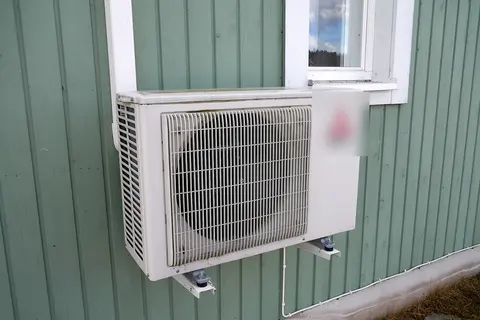
One ductless head can serve the main area of many West side electric homes, as long as baseboards keep covering the back rooms. Add heads only for rooms a load calculation shows it can't reach, or rooms kept behind closed doors.
The verdict, by situation
If you have an open main room and working baseboards in the bedrooms
Start with one head. The NEEA pilot put units in main living zones and left the electric heat in place, and homes still saved power.
If people sleep with bedroom doors shut and want those rooms warmer than the baseboards keep them
Price a head for those rooms. ENERGY STAR says heat is impossible to move through a closed door.
If you have an electric furnace and would pull it out entirely
Several heads or a ducted system, not one head. BPA's study found a single unit doesn't heat back rooms as effectively as a ducted system. Compare ductless and ducted first.
If a bid adds a head to every room, including rooms you barely use
Ask for the room-by-room load numbers. The DOE consumer guide warns oversizing can cost too much, hurt comfort and lead to mold.
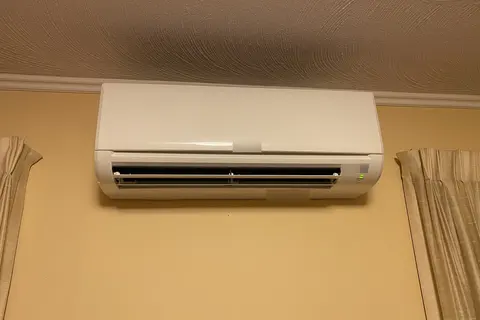
Side by side
| Compare | One head | Several heads |
|---|---|---|
| Rooms reached | Main zone, some spill to adjacent rooms | Each room with a head |
| Closed-door rooms | Baseboard or other heat still needed | Served directly |
| Evidence | Metered in 95 Northwest homes | No metered multi-head figure found |
| Baseboards afterward | Bedrooms and far rooms keep running | Can run less in rooms with a head |
| Sizing risk | Undersized for the whole house if you expect that | Oversizing if rooms have small loads |
| Clark rebate | $900 | $900, single or multi-head |
| Smoke | Add an air cleaner | Same; EPA says these units usually lack PM2.5 filters |
Sources: NEEA field metering, Clark ductless program. We found no field study comparing one head with several in Washington houses, so the second column is reasoning from room layout and not a measured saving.
What would change the answer
- You keep the bedroom doors open at night. Heat can then reach adjacent rooms, as the pilot saw, and one head has a better chance.
- The bedroom baseboards are broken. Then you are choosing a new heat source for those rooms either way.
- You run a plug-in heater in a back room every winter. That's the sign the BPA study describes, and the heater or another head page covers it.
- The floor plan is a long hallway with a door at the end. Expect one head to do less there.
- You want cooling upstairs. A head downstairs won't settle that, so read one cool room or the whole house.
- You are on Tacoma Power with a large job. See the "units" wording below before you count on the higher rebate.
What it costs, with dates
No official installed price for one head or several turned up, so ask for it in writing. Have each bid price the job both ways, with a separate line for every head, the outdoor unit or units, line-set runs, electrical work and permits. As of November 2026, Clark Public Utilities pays the same $900 for single or multi-head, so a second head adds no rebate there.
Tacoma Power lists ductless at $1,000 for "up to 4 units" and $650 for "5+ units". Its page doesn't spell out what it's counting, so ask whether "units" means indoor heads, outdoor units or dwellings. PSE lists a $1,500 rebate and a $2,400 Efficiency Boost rebate based on income (archived copy, May 2026) for converting from electric resistance; confirm with the utility how it treats multiple heads.
Running costs matter too. The state's average electric price was 14.63 cents per kWh in August 2026, and every room you shift from baseboard to a head uses less of it. See the running-cost page.
Who does the work
Sizing is the contractor's job, and the number of heads should follow from it. ENERGY STAR says to size with Manual J, so ask to see the room-by-room result. Verify the firm's registration with L&I. Only certified technicians should handle refrigerant under EPA Section 608, and line sets and wiring are never a homeowner task. Your part is to wash filters, keep the outdoor unit clear and check a tripped breaker.
Why doesn't one head warm the back rooms?
Heat has to travel there, and doors and hallways get in the way. BPA's study of homes with electric forced-air furnaces found many occupants used a 120-volt heater in a back room after adding a ductless unit.
That doesn't sink the one-head plan. Those homes saved about 5,500 kWh, and the back-room heater was the trade-off. In the zonal homes of the NEEA pilot, some occupants simply kept bedrooms cooler on purpose.
How do you test the need before paying for more?
Live with one winter of one head if the bedrooms have working baseboards. You'll learn which rooms stay cold and how often the old thermostats click on.
Ask your contractor whether the outdoor unit could take another head later. That's a question for the bid, since we found no source that says every system can. See how this fits a whole baseboard house and the wider West side list.
Parts and examples
Plumbing Supply and More, which shares an owner with this site, has a page of condenser pads and pans. Those are the sort of supports a bid may list under the outdoor unit. A contractor installs them, and the page is useful mainly for comparing what your bid says.
What people ask next
Do bedroom baseboards have to stay on a thermostat if a head covers the hall?
Keep them working. The metered pilot homes kept running resistance heat in outer zones after the install: 2,400 kWh a year on average in Puget Sound.
Does adding a second head later earn another utility rebate?
Don't count on it. Tacoma Power lists rebates for existing ductless heat pumps as "Not available", and PSE's conversion rebate excludes existing heat pump customers (archived copy, May 2026; confirm with the utility).
Is a head in a room I rarely use a waste?
It can be. The DOE guide warns against oversizing, and a low-use room's small load is a reason to ask for the Manual J numbers before you pay for it.
Decide next
Ductless heat pump or keep the baseboard heaters?
- Ductless heat pump, baseboards stay
- West side electric homes with an open main living area
- Baseboards alone
- Small or lightly heated homes, or homes that lean on wood
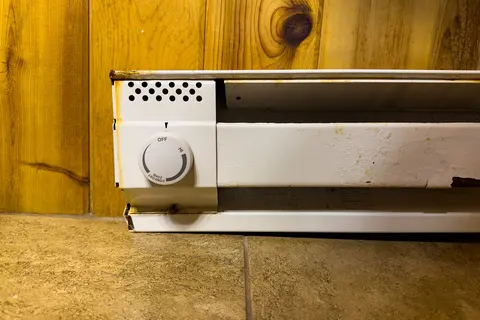
Space heater or another ductless head for the cold back room?
- Space heater
- Short, occasional use in a room you're in and awake
- Wall baseboard
- A room that already has a working baseboard
- Another head
- A room in nightly use all winter
Ductless or ducted heat pump for this house?
- Ductless
- No ducts, or ducts in poor shape, with baseboards to cover far rooms
- Ducted
- Sound ducts already reaching every room, often from an old furnace
Where this came from
- NEEA/Ecotope: Ductless heat pump field metering report, checked November 3, 2026.
- BPA/Ecotope: Ductless heat pumps in forced-air homes, checked November 3, 2026.
- ENERGY STAR: Ductless heating and cooling, checked November 3, 2026.
- DOE: Home heating and cooling consumer guide, checked November 3, 2026.
- EPA: Heat and smoke guidance, checked November 3, 2026.
- EPA: Section 608 technician certification, checked November 3, 2026.
- EIA: Electric Power Monthly Table 5.6.A, checked November 3, 2026.
- Clark Public Utilities: Ductless heat pump program, checked November 3, 2026.
- Tacoma Power: Heat pump rebates, checked November 3, 2026.
- PSE: Electric resistance to heat pump rebate (archived copy, May 2026), checked November 3, 2026.
- L&I: Verify a contractor, checked November 3, 2026.