Decisions Wildfire smoke Both sides
HEPA air cleaner or MERV 13 filter for wildfire smoke?
HEPA room cleaner or MERV 13 furnace filter
Compared by the people who run this site. Updated . Rebates and prices checked November 3, 2026.
Choosing a HEPA air cleaner or MERV 13 filter depends first on whether you have ducts. No ducts, as in most baseboard and ductless homes, means a room cleaner sized by its smoke CADR. With forced air, start with MERV 13 and the fan On, then add a cleaner in the room where you sleep.
The verdict, by situation
If you have ducted forced air and a filter slot that will take it
MERV 13 first. EPA says "Most furnaces and HVAC systems can accommodate a MERV 13 filter", if it is replaced frequently.
If your house has baseboards, wall heaters or ductless heads only
HEPA room cleaner. There is no duct filter to upgrade, and EPA says mini-split and window units typically lack filters for PM2.5.
If someone at home is sensitive to smoke, and you have ducts
Both. Run MERV 13 through the house, then keep a sized cleaner in one clean room.
If your filter slot or fan can't take MERV 13
The highest filter it allows, plus a room cleaner. EPA's wording is MERV 13 or as high as your fan and slot allow, with a snug fit.
If a product makes ozone, or offers ions or UV you can't switch off
Neither. Skip it. Washington DOH's rule for a HEPA unit is "Filter only - no ionic, ozone, or ultraviolet (UV)."
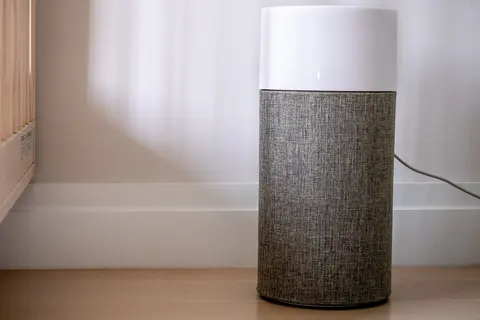
Side by side
| Compare | HEPA room cleaner | MERV 13 furnace filter |
|---|---|---|
| Covers | One room, by CADR | Ducted areas, while the fan runs |
| Needs | An outlet | Ducts, a blower and a slot that fits |
| Works in a baseboard house | Yes | No |
| Settings | Filter only, per DOH | Fan On, not Auto; recirculate or close the outdoor damper |
| Performance number | Smoke CADR | At least 50% removal of smallest particles tested |
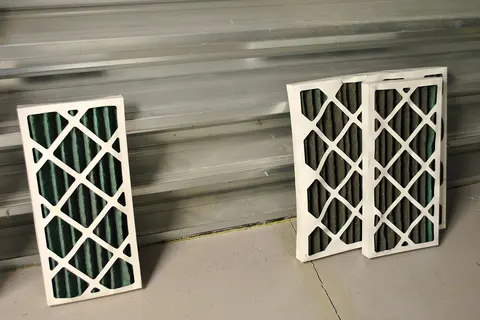
| Filter changes | Per the maker | Frequently in smoke; at least every 3 months generally |
| Fit check | Room size | Snug in the slot |
Sources: EPA: guide to air cleaners, EPA: wildfires and indoor air, Washington DOH: smoke, ENERGY STAR: heating and cooling. We found no agency figure comparing a whole-house MERV 13 with a room HEPA unit in the same home, so this page doesn't say one cleans more. It can't show how leaky your house is either.
What would change the answer
- The furnace fan already struggles or the slot is thin: ask a contractor before moving to a denser filter.
- You run the system on Auto and can't leave the fan On: EPA says the air is cleaned only while cooling in that case, so a room cleaner matters more.
- The room you sleep in is larger than the cleaner's CADR allows: size up or close off a smaller room.
- Smoke is still getting in with everything closed: EPA says to consider shelter elsewhere.
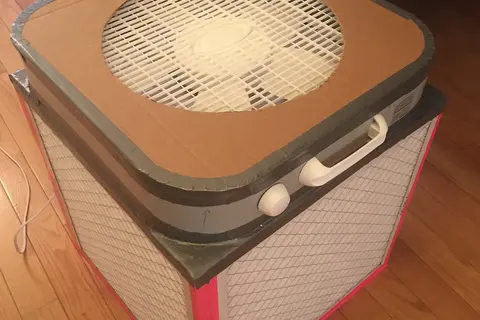
- Room cleaners are unavailable or unaffordable in a long smoke event: a box fan with a filter is EPA's fallback, within its limits.
What it costs, with dates
Nothing here calls for an installed price, and we found no official one for a filter upgrade or for fitting a thicker cabinet, so ask for a written bid if a slot change comes up. It should itemize the filter cabinet, any duct changes and a check of how the blower copes.
We found no utility rebate for a filter or a room cleaner on the heat pump and weatherization pages checked for this site, as of November 2026. Running the fan all the time or a room cleaner all day does add electricity. Read the watts on the cleaner's label and use your rate; Washington's residential average was 14.63 cents per kWh in August 2026.
Expect repeat filter purchases, and how often depends on the smoke. For room cleaners, EPA's table below is what you shop by.
EPA's CADR guide, 8-foot ceiling
| Room size (sq ft) | Smoke CADR (cfm) |
|---|---|
| 100 | 65 |
| 200 | 130 |
| 300 | 195 |
| 400 | 260 |
| 500 | 325 |
| 600 | 390 |
Source: EPA: guide to air cleaners. By our arithmetic each row works out to 0.65 cfm per square foot; EPA gives the table, not that ratio. Rooms with taller ceilings aren't in it. Use the CADR figure for smoke, not the ones for dust or pollen. California's certified list is one way to screen models.
Who does the work
Changing a filter is yours to do. Switch the system off first, pull the old filter and slide the new one in with a snug fit, following the arrow on the frame. Setting the fan to On is a thermostat change. If you can't find a recirculate setting or outdoor damper, ask an HVAC contractor to show you, and check them on L&I's tool first.
Anything beyond that, such as a new filter cabinet or duct changes, goes to the contractor. Look up who pulls the permit if the job grows.
Why does the fan setting matter so much?
Because air only gets filtered when it moves. EPA says to set the fan to "On" rather than "Auto" during smoke, and to recirculate or close the outdoor damper. Its heat and smoke guide adds that with central AC, the air otherwise only gets cleaned while the system cools.
On Auto, the blower stops between cycles, and a filter can only work on air that reaches it.
Are ozone machines an alternative to either?
No. EPA says that at levels within public health standards, ozone "is generally ineffective in controlling indoor air pollution", and no federal agency has approved these machines for occupied spaces. California's air board "recommends that ozone generators not be used, except for approved industrial purposes."
Read the description of any cleaner closely. Washington DOH's plain instruction, "Filter only", rules out ionic, ozone and UV features.
When should this be ready?
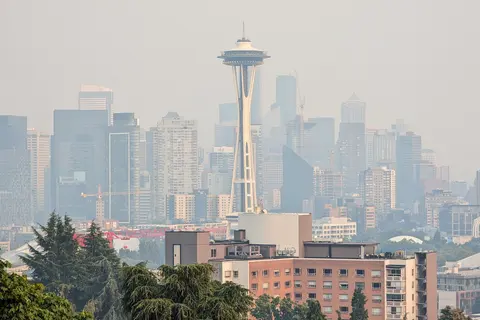
Before May. DOH says smoke season typically starts in July or August but can begin as early as May. Keep spare filters on hand. Plan your room, and how to run it during heat, using windows open or closed. The west side and east side overviews show where smoke fits among your other decisions.
Parts and examples
To compare filter sizes and MERV ratings, Plumbing Supply and More's air filter section is one place to look. The store shares an owner with this site, so weigh that as you read. Match the size printed on your current filter, and ask a contractor if yours is an unusual thickness.
What people ask next
How do I know whether my furnace fan can handle a MERV 13 filter?
Check the slot and the furnace manual, or ask your service contractor. EPA says most systems can take one if it is replaced frequently, and to go as high as your fan and slot allow if not.
Do I need a smoke CADR rating if a cleaner says HEPA on the box?
Yes. HEPA describes the filter, while EPA's size table runs on smoke CADR: a 300 square foot room calls for 195 cfm.
Does a MERV 13 filter help on a heat pump system with ducts?
The same EPA advice applies to any HVAC system with a filter slot: the rating your fan and slot allow, and the fan On.
Decide next
Box fan filter or a real air cleaner for smoke?
- Box fan with filter
- Emergencies, when no sized cleaner is available or affordable
- Air cleaner with a smoke CADR
- Anyone who can get one before smoke season
Windows open or closed when it's smoky and hot?
- Keep them closed
- Smoke outside, safe temperature inside
- Open when the air improves
- A clean break in the smoke, even a short one
- Go somewhere cooler
- Too hot to stay safe, or too much smoke indoors
Should you cool one room or the whole house?
- One cool room
- West side homes, no ducts, a modest budget, a room you can close
- Whole-house cooling
- East side summers, existing ducts, people home through the heat
Where this came from
- EPA: guide to air cleaners in the home, checked November 3, 2026.
- EPA: wildfires and indoor air quality, checked November 3, 2026.
- EPA: heat and smoke guide (PDF), checked November 3, 2026.
- EPA: create a clean room, checked November 3, 2026.
- EPA: ozone generators sold as air cleaners, checked November 3, 2026.
- Washington DOH: protect yourself from smoke, checked November 3, 2026.
- California Air Resources Board: ozone-generating air purifiers, checked November 3, 2026.
- California Air Resources Board: certified air cleaners, checked November 3, 2026.
- ENERGY STAR: heating and cooling, checked November 3, 2026.
- EIA: Electric Power Monthly Table 5.6.A, checked November 3, 2026.
- L&I: verify a contractor, checked November 3, 2026.