Decisions Oil, propane and wood Both sides
Stay on heating oil, or switch to a heat pump?
Stay on oil for now or Switch to a heat pump
Compared by the people who run this site. Updated . Rebates and prices checked November 3, 2026.
Between oil and a heat pump, the answer leans toward the heat pump, especially in Seattle, where oil homes have the state's clearest offer: a $2,000 instant rebate and a possible $4,000 bonus as of November 2026. The old tank still has to be dealt with, so budget for that too.
The verdict, by situation
If you heat with oil in Seattle
Switch while the rebates last. Clean Heat offers $2,000 for a qualifying heat pump from the program's list, installed by a participating contractor, with a $4,000 bonus at 81%-150% of Area Median Income for installations completed by May 30, 2027.
If your Seattle household falls below the program's lower income limit
Call the city first. You may qualify for a free heat pump, installation and tank decommissioning through the Office of Housing, per Clean Heat.
If you heat with oil outside Seattle, in Tacoma Power's area
Ask about variable-speed. Tacoma Power lists $1,000 for homes with non-electric heat, as of November 2026, with a participating contractor.
If you're elsewhere and your oil furnace is over 15 years old
Bid a heat pump, without counting on a rebate. That age is ENERGY STAR's prompt to evaluate. State HEAR may help at or below 150% of Area Median Income.
If you suspect your tank is leaking
Deal with the tank first. Stop deliveries and follow the steps on remove or close an oil tank right away, before any equipment decision.
Side by side
| Compare | Oil furnace | Heat pump |
|---|---|---|
| Federal minimum | 83.0% AFUE, non-weatherized | Split system: 14.3 SEER2, 7.5 HSPF2 |
| Fuel cost per million Btu of heat, our arithmetic | $31.45 at 83% AFUE, 2024 price | $11.43 at COP 3.05, 2024 price, Puget Sound |
| Upgrading within type | ENERGY STAR oil: up to 4% better, about $90 a year | Not applicable |
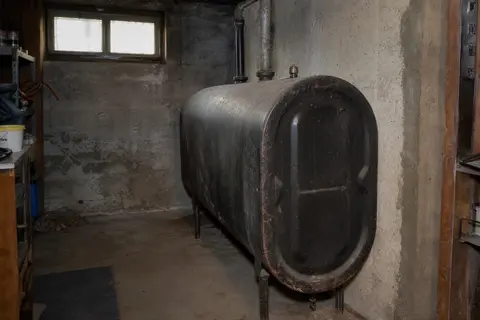
| Tank on the property | Stays in service | Must be decommissioned after a year out of service, under most fire codes |
| Seattle rebate, as of November 2026 | None | $2,000, plus $4,000 bonus by income |
| Summer cooling | None by itself | Yes |
| Yearly check | Trained professional, per DOH | Not a combustion appliance |
Sources under the table: federal minimums, EIA prices, NEEA metering, ENERGY STAR furnaces, PLIA on decommissioning (archived copy, March 2025), DOH. The table can't show the condition of your tank, ducts or electric panel.
What would change the answer
- Moving outside Seattle's bonus window. Bonus rebates require installation completed by May 30, 2027, so a late start could cost you the $4,000.
- A household income above the bonus limit. Limits run by household size, for example $81,700-$172,650 for one person and $116,650-$246,600 for four.
- A cleanup problem. Contaminated soil moves the tank to the top of the list, and it's no longer covered by the old state insurance.
- Asbestos on an old oil furnace. EPA lists "Oil and coal furnaces and door gaskets with asbestos insulation." Exposure generally comes when it's disturbed, so leave it alone and let a qualified professional handle it.
- Rooms that ductless can't reach. BPA's research says ductless "does not heat back rooms as effectively as a ducted system." If your oil furnace feeds sound ducts, compare ductless or ducted.
- A low-cost oil contract, well under the prices quoted here. Run your own numbers before you decide.
What it costs, with dates
A dated price first: EIA's weekly U.S. residential heating oil average was $6.233 a gallon for the week of October 26, 2026. It's a national number, published only October through March, and no Washington row appears.
Next, our arithmetic on EIA's 2024 Washington prices: $26.10 per million Btu for fuel oil and $34.87 for electricity. Divide by an 83% AFUE rating and by the 3.05 COP metered in Puget Sound ductless pilot homes in 2008-09, and you get $31.45 against $11.43 per million Btu of heat. Treat these as 2024 statewide averages rather than your bill. AFUE is a rating, not a measurement, and duct losses aren't included. The East side's lower metered COP is on what heat costs.
Nobody official prints an installed price for a heat pump conversion or a tank job, and this site won't either. A written bid should itemize the heat pump and its ratings, Manual J load calculation, electrical work, permits, furnace removal and the tank decommissioning as a separate line. No federal credit applies, per the IRS FAQ. The city's February 2026 post puts the Clean Heat total at up to $6,000.
Who does the work
Three separate trades may touch this job. An HVAC contractor registered with the state installs the heat pump, which you can confirm on L&I's lookup. In Seattle, a refrigeration permit is needed for any split system heat pump, and the city ties that work to licensed refrigeration contractors. Your oil dealer pumps out the tank, and a certified decommissioner handles the tank itself. Never pump or remove a tank yourself.
You can keep the filter changed and check a breaker or switch. Book the yearly furnace check DOH recommends for as long as you burn oil. CDC notes oil furnaces make CO. If a CO alarm sounds, get everyone out first, then call 911 from outside.
How many Washington homes still burn oil?
In Seattle, about 6,000 households, by the city's February 2026 count. No equally firm statewide number exists here, since EIA's 2020 housing survey withholds the share of fuel oil in Washington.
If you're outside the city, the rebate landscape is thin. PSE's rebate listing showed no oil conversion rebate (archived copy, July 2026), so confirm with the utility. Snohomish County PUD and Clark Public Utilities tie theirs to electric heat. The oil house starting page and the main starting page can point you to related decisions.

Should you replace an oil furnace with a new oil furnace?
You can, but the efficiency gain is small. ENERGY STAR says an oil furnace can be up to 4% better than baseline, saving about $90 a year. A new oil furnace also keeps you tied to the tank and to fuel deliveries, and keeps the tank question open for the next owner. If your tank is sound and the furnace is newer, staying put for a few years is still reasonable, but watch the Seattle bonus deadline if it applies to you.
What people ask next
Does switching off oil mean I have to remove the tank?
The tank has to be decommissioned, by removal or permanent closure, under most local fire codes after a year or more out of service. Seattle's rules require a permit and a certified decommissioner.
Can I use Seattle's Clean Heat rebate with my own installer?
Only if the installer is a participating contractor. City Light's page says a qualified system and a participating contractor are required.
Is a Seattle oil-to-heat-pump rebate paid after the job?
The city calls the $2,000 an instant rebate. Ask your participating contractor how the bonus shows up on your bid.
Decide next
Should an old heating oil tank be removed or closed in place?
- Remove the tank
- A suspected leak, or a tank you won't leave for the next owner
- Close it in place
- No leak suspected, and the decommissioner and fire marshal both allow it
Take a rebate now or wait for better money?
- Take what is open now
- Anyone with a failing system or a utility offer that fits
- Wait for HARP and HOMES
- A working system, income under 150% AMI, and no deadline

Ductless or ducted heat pump for this house?
- Ductless
- No ducts, or ducts in poor shape, with baseboards to cover far rooms
- Ducted
- Sound ducts already reaching every room, often from an old furnace
Where this came from
- City of Seattle: Clean Heat program, checked November 3, 2026.
- Seattle Greenspace: oil-free city post, February 2026, checked November 3, 2026.
- Seattle City Light: home energy solutions, checked November 3, 2026.
- Seattle Fire Department: decommissioning oil tanks, checked November 3, 2026.
- Seattle SDCI: furnace permit infographic, checked November 3, 2026.
- Tacoma Power: heat pump rebates, checked November 3, 2026.
- Snohomish County PUD: heating rebates, checked November 3, 2026.
- Clark Public Utilities: ductless heat pump program, checked November 3, 2026.
- Washington Commerce: HEAR, checked November 3, 2026.
- Puget Sound Energy: heating rebates (archived copy, July 2026), checked November 3, 2026.
- PLIA: heating oil tank decommissioning (archived copy, March 2025), checked November 3, 2026.
- EIA: heating oil and propane weekly prices, checked November 3, 2026.
- EIA: Washington residential energy prices, 2024, checked November 3, 2026.
- EIA: RECS 2020 state space heating fuels, checked November 3, 2026.
- Northwest Energy Efficiency Alliance: ductless field metering report, checked November 3, 2026.
- Bonneville Power Administration: ductless with electric forced-air furnaces, checked November 3, 2026.
- Code of Federal Regulations: 10 CFR 430.32, checked November 3, 2026.
- ENERGY STAR: furnaces, checked November 3, 2026.
- ENERGY STAR: when to replace, checked November 3, 2026.
- EPA: learn about asbestos, checked November 3, 2026.
- IRS: FAQs on sections 25C and 25D under Public Law 119-21, checked November 3, 2026.
- L&I: verify a contractor, checked November 3, 2026.
- Washington DOH: carbon monoxide, checked November 3, 2026.
- CDC: carbon monoxide, checked November 3, 2026.