Decisions Cooling Both sides
Should you cool one room or the whole house?
One cool room or Whole-house cooling
Compared by the people who run this site. Updated . Rebates and prices checked November 3, 2026.
Choosing one cool room or whole-house cooling depends mostly on which side of the Cascades you're on and whether you have ducts. Many west side houses can get by with one good room plus a place to go. East side summers run long enough, and hot enough, to make whole-house cooling a fair goal.
The verdict, by situation
If you're on the west side with no ducts and no cooling yet
One cool room first. Sea-Tac averages 3.8 days a year at 90F or more, and a room unit is a small first step you can build on.
If you have a furnace and ducts in good shape
Whole house. Ducts are already in place, so adding AC or a heat pump is the natural comparison rather than room units.
If you live in the Yakima or Tri-Cities area
Whole house, if you can. NOAA normals show 40.2 days at 90F or more in Yakima and 54.7 in Pasco, a lot of hours to spend in one room.
If your house has two storeys and no AC
One room on the lowest floor. Washington DOH points people without AC to the lowest floor, out of the sun.
If smoke, more than heat, is your first worry
One clean, cool room. EPA's clean room plan is built around a single closed-up room with a correctly sized air cleaner.
Side by side
| Compare | One cool room | Whole-house cooling |
|---|---|---|
| WA homes using it | Individual units: 25% | Central AC: 30% |
| Sizing method | ENERGY STAR, by room area | Manual J load calculation |
| Too big means | Damp, clammy room | Too much cost, poor comfort, possible mold |
| Sleeping and daytime | Everyone shares one room | Normal use of the house |
| Smoke filtering | Add an air cleaner | MERV 13 possible, fan On all the time |
| Who installs | Portable: no installer. Window unit: secured per its manual, or by someone qualified | Contractor, with permits |
| Rebate found | None | Heat pumps only, mostly for electric heat |
Sources: EIA: RECS 2020, ENERGY STAR: room air conditioners, DOE consumer guide, EPA: heat and smoke guide. The two EIA shares add to more than the 53% of homes using AC, so some homes report both. The table can't show how quickly your walls and attic give back the day's heat.
What would change the answer
- Someone at home can't easily climb stairs or share a room: one room stops working as the plan, or that room must be on their floor.
- Your furnace needs replacing anyway: a heat pump comes into the same bid, so see the whole-house heat pump options.
- The existing ducts are leaky or sit in a crawlspace: read seal or replace first.
- The one room you can close is on the sunny side: DOH says awnings or louvers can reduce heat entering by as much as 80 percent, which may be enough to change the room you pick.
- Your summer power is unreliable: no cooling plan survives an outage, so EPA's advice to seek shelter elsewhere comes sooner.
What it costs, with dates
We found no official installed price for central AC, ductless or any other whole-house system, and we won't print a guess. Ask for written bids that separate equipment, electrical work, duct work, permits and removal of anything old.
Whole-house jobs are where rebates may apply, and mostly for heat pumps replacing electric heat. As of November 2026, for example, Tacoma Power lists $1,000 for an air-source heat pump from zonal or electric forced-air heat, and Clark Public Utilities lists $1,000 for an electric furnace to a central heat pump. We found no rebate for adding cooling-only AC. Rebate or wait covers income-based money.
Running cost scales with what you cool. Washington's residential electricity averaged 14.63 cents per kWh in August 2026. We have no official figure for one room against a whole house.
Who does the work
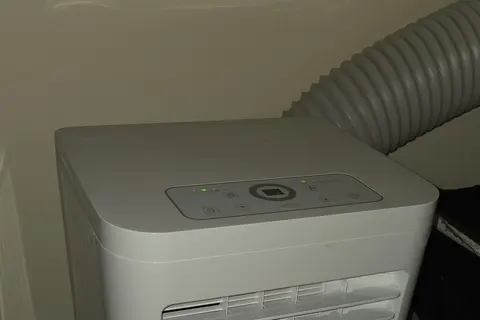
A portable needs no installer. A window unit must be secured exactly as its manual says; if the sash or sill is doubtful, have someone qualified fit it or choose a portable. Your upkeep is the filter, the seal and a breaker check if it stops.
Whole-house work belongs to a contractor. Ask for a Manual J calculation, check the company on L&I's verification tool, and settle who pulls which permit using the permit page. Any refrigerant work needs an EPA-certified technician.
Which room should you pick?
Pick the lowest, shadiest room that everyone can reach and that has a door. DOH's advice for homes without AC is the lowest floor, out of the sun. EPA's clean room adds one more test: you must be able to close it up without making it hard to get out.
Then size the cooler for that room. ENERGY STAR sizes by floor area at an 8-foot ceiling, cuts 10% for heavy shade and adds 600 BTU per person over two. If the whole household will sleep in there, that last adjustment counts.
Can one room also be your smoke room?
Yes, and it is the simplest way to cover both. Add a filter-only air cleaner to the same room, because EPA says window and mini-split units typically lack filters for PM2.5. The room size decides the cleaner, as shown on HEPA cleaner or MERV 13 filter.
If you do have central AC, EPA says to run the fan all the time, or the air is cleaned only while the system is cooling.
When is neither option enough?
When the house stops being safe, leave. EPA says to consider shelter elsewhere if you can't stay cool at home, the power goes out or too much smoke is still getting in. In Washington, 2-1-1 finds cooling centers.
June 2021 is the reason to plan for this. Spokane reached 109F and Sea-Tac 108F. If someone at home shows signs of heat stroke, such as confusion, slurred speech or fainting, call 911. The hubs for the west side, the east side and the no-AC house carry this planning further.
What people ask next
Will one ductless head cool the rest of my house if I leave the doors open?
Don't count on it for rooms beyond the main area. ENERGY STAR says heat is impossible to move through a closed door, and BPA's study found a ductless unit "does not heat back rooms as effectively as a ducted system", which was about heating. We found no equal cooling study.
Can I start with one room and go whole-house later?
Yes. A plug-in room unit involves no change to the house, so it doesn't commit you to anything. You lose nothing but the unit's cost if you later add a central system.
Does a bigger room unit cool more of the house?
Not reliably. ENERGY STAR warns that an oversized unit leaves the room damp and clammy, so size for the room you mean to use.
Decide next
Are fans enough, or does your Washington house need AC?
- Fans
- Mild days when the indoor reading stays within the agency lines
- Air conditioning
- Any home planning for a heat wave, or for people at home all day
Portable AC or window AC for a Washington house?
- Portable AC
- Windows that can't hold a unit, ideally with a two-hose model
- Window AC
- Sashes that can hold a unit, on a model whose damper closes
Windows open or closed when it's smoky and hot?
- Keep them closed
- Smoke outside, safe temperature inside
- Open when the air improves
- A clean break in the smoke, even a short one
- Go somewhere cooler
- Too hot to stay safe, or too much smoke indoors

Where this came from
- NOAA: 1991-2020 normals, Sea-Tac, checked November 3, 2026.
- NOAA: 1991-2020 normals, Yakima, checked November 3, 2026.
- NOAA: 1991-2020 normals, Pasco, checked November 3, 2026.
- NWS: Spokane annual climate report, checked November 3, 2026.
- NWS: Seattle climate data (NOWData), Sea-Tac daily highs, checked November 3, 2026.
- NWS: heat illness, checked November 3, 2026.
- Washington DOH: hot weather safety, checked November 3, 2026.
- Washington DOH: extreme heat, checked November 3, 2026.
- EPA: create a clean room, checked November 3, 2026.
- EPA: heat and smoke guide (PDF), checked November 3, 2026.
- EPA: Section 608 technician certification, checked November 3, 2026.
- EIA: RECS 2020, air conditioning by state (PDF), checked November 3, 2026.
- EIA: Electric Power Monthly Table 5.6.A, checked November 3, 2026.
- ENERGY STAR: room air conditioners, checked November 3, 2026.
- ENERGY STAR: ductless heating and cooling, checked November 3, 2026.
- DOE: home heating and cooling consumer guide (PDF), checked November 3, 2026.
- BPA/Ecotope: ductless in homes with electric furnaces (PDF), checked November 3, 2026.
- Tacoma Power: heat pumps, checked November 3, 2026.
- Clark Public Utilities: heat pump program, checked November 3, 2026.
- L&I: verify a contractor, checked November 3, 2026.