Decisions Wildfire smoke Both sides
Box fan filter or a real air cleaner for smoke?
Box fan with filter or Air cleaner with a smoke CADR
Compared by the people who run this site. Updated . Rebates and prices checked November 3, 2026.
Between a box fan filter and an air cleaner, what you can get mostly settles it: EPA recommends the DIY version only when products of known performance aren't available or affordable. Buy a sized air cleaner if you can. Build the box fan if you can't, and follow the fan rules exactly.
The verdict, by situation
If smoke season hasn't started and you can afford a sized cleaner
Air cleaner. Pick one from EPA's room-size table by its smoke CADR, so you know what it delivers.
If smoke is here, stores are empty and you own a fan made in 2012 or later with a UL or ETL mark
Box fan with a filter. EPA's research page names those conditions, and calls it a stopgap rather than a permanent setup.
If your only fan is older than 2012 or has no UL or ETL mark
Attended only, and not overnight. EPA says not to leave an older fan unattended or use it while sleeping, so treat it that way or look for another fan.
If you need clean air where you sleep
Air cleaner, or a newer listed fan. That is what the fan-age rule above comes down to.
If you already have a cleaner but it is too small for the room
Close off a smaller room first. A smaller room needs less CADR, and EPA's clean room steps work the same way.
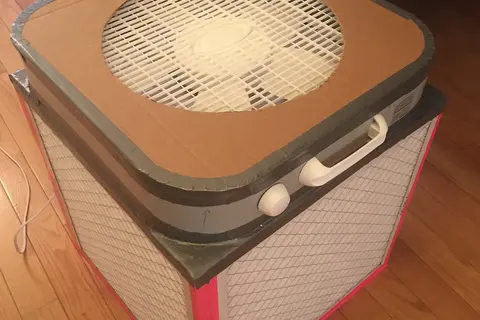
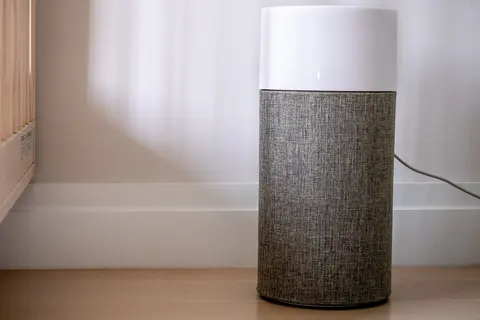
Side by side
| Compare | Box fan with filter | Air cleaner with a smoke CADR |
|---|---|---|
| Stated performance | EPA "cannot assure" results for all DIY cleaners | A CADR number you can match to the room |
| EPA's stance | Only when known products aren't available or affordable | The route it points to first |
| Fan age and listing | 2012 or newer, UL or ETL | Not applicable |
| Unattended or asleep | Older fans: no | No fan-age rule that we found |
| Cord | No extension cord, per EPA | Follow the maker's manual |
| Dirty filter | "almost completely ineffective" | Follow the maker's schedule |
| Filter life | May need changing "every few weeks or days" | Per the maker |
| Placement | At least a foot from walls, per DOH | Per the maker |
Sources: EPA: DIY air cleaner research, EPA: guide to air cleaners, Washington DOH: smoke. The table can't tell you how much a given DIY build removes, because EPA doesn't promise a result for every version.
What would change the answer
- You can buy a sized cleaner this week: stop reading about fans and buy it.
- Your fan is unmarked or older than 2012: the DIY plan can't run overnight or unattended.
- The only outlet is across the room: EPA's no-extension-cord line means moving the fan, not stretching a cord.
- You can't replace filters when they clog: EPA calls a dirty one "almost completely ineffective", so a build without spares doesn't last.
- Heat is as big a problem as smoke: neither device cools a room, so read one cool room or the whole house.
What it costs, with dates
We found no official price for a DIY build or a room cleaner, and no rebate for either as of November 2026 on the utility pages checked for this site. So there is no honest dollar comparison to print, and no installed price applies.
Compare instead what you will keep buying. EPA says DIY filters may need changing "every few weeks or days", which a single purchase won't cover. For a room cleaner, price the replacement filter before you pick the model. Written bids only come in if you hire someone, which neither option needs.
If you want more whole-house filtering, the running-cost and fan points are covered on HEPA cleaner or MERV 13 filter.
Who does the work
Both options are yours to set up, without a contractor or permit. Your job is to read the fan's label for the year and the UL or ETL mark, plug it straight into a wall outlet, keep it at least a foot from walls and watch the filter.
Nothing here should involve opening the fan, altering its wiring or running it from a damaged cord. If a breaker trips or the fan smells hot, unplug it and stop using it. A filter upgrade on a furnace is a separate step, and if that turns into duct or cabinet work, use a contractor you've checked on L&I's tool.
What do EPA and Washington DOH each say about box fans?
They agree on caution, and each adds its own detail. EPA's page says:
- Use only 2012 or newer fans with a UL or ETL mark. Older fans: don't leave them unattended or use them while sleeping.
- Don't use an extension cord.
- UL testing found no observable fire hazards, but that was limited to the models tested.
- EPA "cannot assure" results for all DIY air cleaners.
Washington DOH says to keep the fan at least a foot from walls, and notes that box fans "are not designed to operate with a filter attached". Read both before you build one. They are the reason this page treats DIY as a fallback.
Where should either one go?
In the room you can close up and spend the most time in. EPA's clean room means closing windows and doors, though not in any way that makes it hard to get out. Running either device in a large open room spreads its effect thin.
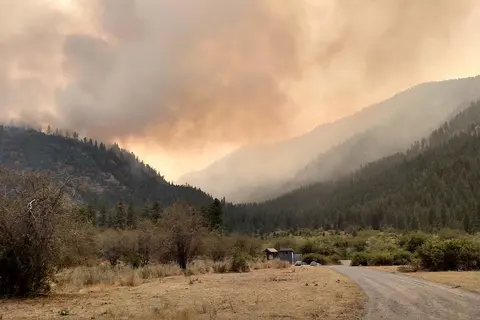
If you can't stay cool in that room, or too much smoke still gets in, EPA says to consider shelter elsewhere. Windows open or closed covers that call. For the context on your side of the state, see the west side or east side overview.
Parts and examples
Plumbing Supply and More's indoor air quality section covers HVAC air-quality gear, and the store shares an owner with this site. We haven't confirmed that it carries room cleaners. Wherever you look, check for a smoke CADR number and filter-only operation.
What people ask next
How can I tell what year my box fan was made?
Look for the date on the fan's label, along with the UL or ETL mark. If you can't find either, treat it as an older fan under EPA's rule: attended only, and not while you sleep.
Can I use a box fan filter as my permanent indoor air cleaner?
EPA doesn't recommend that. Its wording is that DIY cleaners are for when products of known performance aren't available or affordable, and not a permanent fix.
Are tape-together box designs with several filters covered by these rules?
The fan rules still apply, whatever the shape. EPA says it can't assure results for all DIY builds, and we found no separate Washington guidance on multi-filter versions.
Decide next
HEPA air cleaner or MERV 13 filter for wildfire smoke?
- HEPA room cleaner
- Homes without ducts, and one clean room in any home
- MERV 13 furnace filter
- Homes with ducted forced air and a slot that fits
Windows open or closed when it's smoky and hot?
- Keep them closed
- Smoke outside, safe temperature inside
- Open when the air improves
- A clean break in the smoke, even a short one
- Go somewhere cooler
- Too hot to stay safe, or too much smoke indoors
Are fans enough, or does your Washington house need AC?
- Fans
- Mild days when the indoor reading stays within the agency lines
- Air conditioning
- Any home planning for a heat wave, or for people at home all day
Where this came from
- EPA: research on DIY air cleaners for wildfire smoke, checked November 3, 2026.
- EPA: guide to air cleaners in the home, checked November 3, 2026.
- EPA: create a clean room, checked November 3, 2026.
- Washington DOH: protect yourself from smoke, checked November 3, 2026.
- L&I: verify a contractor, checked November 3, 2026.