Decisions Heat, east side East side
Should a Spokane house have a furnace or a heat pump?
Gas furnace or Heat pump with back-up
Compared by the people who run this site. Updated . Rebates and prices checked November 3, 2026.
Choosing a furnace or heat pump in Spokane turns on what heats the house today. Homes on baseboards or an electric furnace have the clearer case for a heat pump with back-up. Gas homes face a closer call, which your own bills and written bids should settle.
The verdict, by situation
If you have a sound gas furnace and the air conditioner is what failed
Keep the furnace and price a heat pump in the AC's place. ENERGY STAR describes dual fuel "for a modest extra cost over an AC system" when the furnace is relatively new. The trade-offs are on dual fuel or all electric.
If baseboards or an electric furnace are your main heat
Heat pump with back-up. Ductless units in Inland Empire pilot homes metered a seasonal COP of 2.41, meaning 2.41 units of heat per unit of electricity, against one from a resistance heater.
If your gas furnace has quit and can't be fixed
Get both priced in writing before you sign. Running costs sit close together, and both fuels have moved since 2024, so no general answer holds for every house.
If your gas furnace runs but is more than 15 years old
Leave it running and collect bids now. ENERGY STAR's age line is a prompt to evaluate, not an order to replace. Use repair or replace to weigh the next breakdown.
If a wood stove is your main heat in Spokane County
Check the changeout program first. Spokane Clean Air lists $2,500 toward a ductless heat pump, as of November 2026, for a stove that is non-EPA certified or 20 or more years old, installed and working. See keep or replace a wood stove.
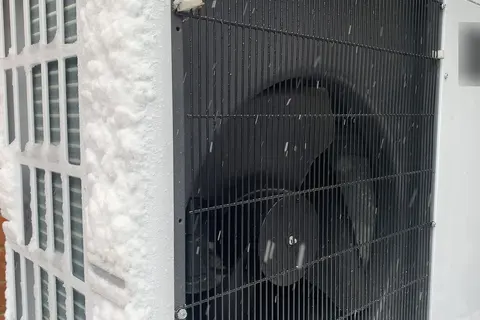
Side by side
| Compare | Gas furnace | Heat pump with back-up |
|---|---|---|
| Federal minimum | 80.0% AFUE, rising to 95.0% for units made on and after Dec. 18, 2028 | Split system: 14.3 SEER2, 7.5 HSPF2 |
| Cold-weather rating | AFUE only | ENERGY STAR Cold Climate: COP at least 1.75 at 5F, capacity at least 70% of its 47F output |
| Local field evidence | No Spokane comparison found | COP 2.41 metered in Inland Empire ductless pilot homes, 2008-09 |
| Fuel cost per million Btu of heat, our arithmetic | $12.26 at 95% AFUE, 2024 price | $14.47 at COP 2.41, 2024 price |
| Summer cooling | None by itself | Yes |
| Avista rebate | None shown | No amount shown (archived copy, June 2026) |
| Combustion safety | CO alarm and yearly professional check | No flame at the unit; any back-up furnace still needs both |
Sources under the table: federal minimums, ENERGY STAR criteria, NEEA metering, EIA prices, DOH. The table can't show your rates, your ducts or how a ducted model behaves, because the local metering covers ductless units only.
What would change the answer
- Your gas price. EIA's annual Washington residential figure went from $12.72 in 2024 to $17.62 in 2025 per thousand cubic feet.
- A confirmed Avista heat pump offer. The single-family rebate page shows no amount (archived copy, June 2026), so confirm with the utility.
- Household income at or below 150% of Area Median Income. That opens the door to state HEAR rebates, which also cover panel and wiring upgrades that new electric equipment requires. Spokane County received $630,000, and the page gives no per-household amount.
- Leaky ducts. ENERGY STAR says air leaks and ducts are sometimes the real source of the problem, which would change what you buy and how large.
- A wood stove you plan to keep burning. Homes with supplemental fuel saved 747 kWh a year against 2,718 for homes without it.
What it costs, with dates
No official or utility source gives an installed price for either system, so none appears here. Ask each bidder to itemize the equipment model and its ratings, the Manual J load calculation, the back-up heat type, duct work, electrical work, permits, removal of old equipment and rebate paperwork.
Running costs are our arithmetic on EIA's 2024 Washington prices: $11.65 per million Btu for gas and $34.87 for electricity. That yields the table's $12.26 and $14.47. At the 2025 gas price, the 95% row would be about $17.0. Electricity moved too: at the state's August 2026 rate of 14.63 cents per kWh, a summer month used only for illustration, our arithmetic gives about $17.8 at COP 2.41 and about $14.1 at COP 3.05. So the gap at newer prices is too close to call. These are statewide averages, not Avista's rates. The COP comes from pilot homes metered in 2008-09, AFUE is a rating rather than a measurement, and duct losses aren't counted. The full set is on what heat costs.
Avista's Washington tariff lists its electric lines from 10.322 to 14.349 cents per kWh and gas lines of $0.58423 and $0.75931 per therm, effective Jan. 1, 2026 (archived copies, 2026). Those are single tariff lines, not the all-in rate on a bill, so confirm with the utility. Dividing a winter bill by its units gets you closer. The IRS FAQ ends federal credits for anything placed in service after Dec. 31, 2025.
Who does the work
A registered HVAC contractor does this work. Check the registration, certification and workers' comp account on L&I's verify tool. Spokane's own mechanical permit rules could not be confirmed, so ask the city's permit office and put in the contract who pulls what. Electrical permits must be bought before work starts. Refrigerant is handled by EPA-certified technicians.
Your part is the filter, clearing snow from around the outdoor unit and checking a breaker or switch. If you smell gas, leave first. Don't touch switches or plugs or use a phone inside. From outside and away, call 911 and Avista at 800-227-9187 (archived copy, October 2025; confirm with the utility). If a CO alarm sounds, get everyone out first, then call 911 from outside, as DOH advises.
How cold does Spokane get for a heat pump?
Cold enough to plan for back-up, but not usually in the extreme range. NOAA's 1991-2020 normals put Spokane's January low at 24.7F and its January high at 34.5F. Its annual normals show 2.2 days a year at 0F or below and 6,462.6 heating degree days. The record low is -30F, from 1888.
Cold-climate models are rated at 5F and keep running below it. ENERGY STAR's ductless page notes that below that point, back-up heats most efficiently. Washington's code also requires controls that stop supplementary heaters above 40F, with a thermostat exception for ductless units that have an integral thermostat. Ask each bidder how their design handles that.
Does summer heat change the choice?
It can, because a furnace alone leaves you without cooling. Spokane normals show 20.8 days a year at 90F or above and a July high of 84.4F. The airport's record high is 109F, set June 29, 2021. If you'd buy AC anyway, one outdoor unit covers both jobs. Inland Empire pilot homes used only about 408 kWh a year for cooling, so that's a comfort and safety gain more than a large bill item. More choices for the region are on the east side starting page.
Parts and examples
To see the furnace types a contractor would be quoting, browse PlumbingSupplyAndMore's furnace category. That store shares an owner with this site. It's for comparing what a bid names, because a furnace is contractor-installed equipment with gas, venting and electrical work this site never suggests doing yourself.
What people ask next
Do heat pumps stop working below 5F in Spokane?
No. Cold-climate models are rated at 5F and keep running below it, though a back-up is normal. The ENERGY STAR Cold Climate criteria set a floor of COP 1.75 at that temperature.
Did Inland Empire ductless pilot homes save as much as Puget Sound homes?
Less on bills. The billing analysis found space heating savings of 792 kWh a year in the Inland Empire and 1,677 in Puget Sound.
Is the Spokane wood stove changeout any use if I only have a gas furnace?
No. The program is built around an existing stove that is non-EPA certified or 20 or more years old, installed and working.
Decide next
Dual fuel or all electric: which heat pump setup fits your house?
- Dual fuel (heat pump plus furnace)
- Houses with a gas furnace that is still relatively new
- All electric (heat pump plus electric back-up)
- Houses with no gas, or a furnace at the end of its life
Should you repair your furnace or AC, or replace it?
- Repair it
- Younger equipment, one clear fault, sound ducts
- Replace it
- Older equipment, repeat faults, or rooms that never felt right
Should you seal your ducts or replace them?
- Seal and insulate
- Ducts that are whole but leak at joints and seams
- Replace the runs
- Torn, crushed or disconnected runs, or a new system that needs different ducts
Where this came from
- Northwest Energy Efficiency Alliance: ductless field metering report, checked November 3, 2026.
- Northwest Energy Efficiency Alliance: ductless billing analysis, checked November 3, 2026.
- ENERGY STAR: air-source heat pumps, checked November 3, 2026.
- ENERGY STAR: heat pump key criteria, checked November 3, 2026.
- ENERGY STAR: ductless heating and cooling, checked November 3, 2026.
- ENERGY STAR: when to replace, checked November 3, 2026.
- ENERGY STAR: heating and cooling, checked November 3, 2026.
- NOAA NCEI: Spokane monthly normals, checked November 3, 2026.
- NOAA NCEI: Spokane annual normals, checked November 3, 2026.
- National Weather Service: Spokane annual climate report, checked November 3, 2026.
- Code of Federal Regulations: 10 CFR 430.32, checked November 3, 2026.
- Washington code: WAC 51-11R-40310, checked November 3, 2026.
- EIA: Washington residential energy prices, 2024, checked November 3, 2026.
- EIA: Washington annual natural gas prices, checked November 3, 2026.
- Avista: Washington single-family rebates (archived copy, June 2026), checked November 3, 2026.
- Avista: Schedule 1 electric tariff (archived copy, 2026), checked November 3, 2026.
- Avista: Schedule 101 gas tariff (archived copy, 2026), checked November 3, 2026.
- Avista: natural gas safety (archived copy, October 2025), checked November 3, 2026.
- Spokane Clean Air: wood stove changeout, checked November 3, 2026.
- Washington Commerce: HEAR, checked November 3, 2026.
- IRS: FAQs on sections 25C and 25D under Public Law 119-21, checked November 3, 2026.
- L&I: verify a contractor, checked November 3, 2026.
- L&I: electrical permits, fees and inspections, checked November 3, 2026.
- EPA: Section 608 technician certification, checked November 3, 2026.
- Washington DOH: carbon monoxide, checked November 3, 2026.