Decisions Damp, crawlspaces and ducts Both sides
Should a Washington crawlspace stay vented or be sealed?
Stay vented, finish the ground cover or Seal it (unvented)
Compared by the people who run this site. Updated . Rebates and prices checked November 3, 2026.
A vented crawlspace with a full ground cover is the Washington code default, and researchers say vents work acceptably most of the time in the marine Northwest. Sealing is a choice with conditions attached, including radon and exhaust rules, and not an automatic upgrade.
The verdict, by situation
If your older house has working vents and plastic that covers only part of the dirt
Stay vented and finish the ground cover. The state residential code calls for six-mil black polyethylene or equal, overlapped 6 inches, run to the foundation wall.
If you live on the east side and the crawl is dry
Stay vented. A Building America article puts the drier West alongside the marine Northwest as places where vents work, and we found nothing Washington-specific that says otherwise.
If there is standing water or a wet wall under the house
Neither yet. Deal with the water. Washington's health department puts fixing moisture first, and plastic over a wet problem hides it.
If a salesperson quotes savings of 15% to 18%
Ask where that number comes from. It is a DOE finding built on humid-climate reasoning, not a Washington result.
If a radon test in the living space came back at 4 pCi/L or higher
Get radon work designed before changing vents. EPA says to fix at that level, and Washington's code ties vent changes to radon venting.
If an oil or gas furnace or water heater sits in the crawl
Ask a heating contractor before sealing anything. Changing the air around fuel-burning equipment is not a homeowner decision, and we found no Washington consumer guidance that settles it.
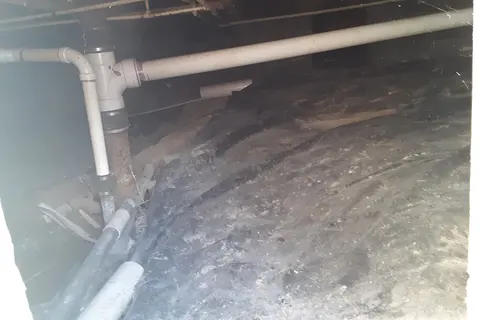
Side by side
| Compare | Vented | Sealed (unvented) |
|---|---|---|
| Code status | Default: vent openings required | Allowed with the conditions below |
| Ground cover | Six-mil black poly or equal, overlapped 6 inches, to the wall | Continuous sealed Class I vapor retarder, 6 inches up the stem wall |
| Vent area | 1 sq ft per 300 sq ft of under-floor area; 1 per 1,500 with a Class I retarder | None |
| Radon rule | Radon vent needed below 1 per 300, or with operable louvers | Radon system per Appendix AF |
| Moving parts | None required | Continuous exhaust, 1 cfm per 50 sq ft |
| Energy evidence | Works "acceptably most of the time" in the marine Northwest | 15% to 18% less heating and cooling energy in a DOE finding, humid-climate reasoning |
| Humidity evidence | No Washington figure found | Over 20% humidity cut in the same DOE finding |
Sources under the table: WAC 51-51-0408, DOE Building America, Building America and WSU article. The code text sets rules. It can't say what your particular crawl needs, and we found no Washington savings figure for sealing.
What would change the answer
- A radon test in the living space comes back high. Radon then shapes the design, whichever way you go.
- The crawl stays wet after the leak and drainage are fixed. That is the moment to pay for an on-site opinion.
- The ground cover is already complete and vents are clear, but floors are still cold. The fix may be insulation or air sealing, ahead of new equipment.
- Your ducts run through the crawl and leak. Read seal or replace ducts first, since leaky ducts can pull particles from crawl spaces.
- A written design meets every rule in the table and solves a problem the vented route did not.
What it costs, with dates
Nothing official prices this work: we found no official installed-price figure for a ground cover, a sealed crawl or a radon system. Written bids should itemize square feet of cover, overlap and wall detail, vent changes, the radon piece, any exhaust fan and its wiring, and permits. Compare the bids on those lines, not the total.
We found no rebate for sealing a crawl. The floor and air-sealing lines below are the nearest offers, as of November 2026, and all need the utility's own contractors.
Utility lines for the floor above a crawl
| Utility | Floor insulation | Air sealing |
|---|---|---|
| PSE | $2.50 per sq ft up to $5,000 (archived copy, April 2026), confirm with the utility | Floor $0.20 per sq ft up to $400 (archived copy, April 2026), confirm with the utility |
| Snohomish PUD | $1 per sq ft, electrically heated homes | No crawl line found |
| Clark Public Utilities | $0.75 per sq ft, electric heat | Attic or crawl $100 |
Sources: PSE insulation rebates (archived copy, April 2026), Snohomish PUD weatherization, Clark weatherization. Other utilities' lines are on your utility's page.
Who does the work
Hire a registered contractor, and check the registration on L&I's verify tool. Ask your local building office whether a vent change or a sealed design needs a permit, since we found no plain statement of that. Your part is limited: look in from the hatch with a flashlight, note how much dirt is showing, photograph it and keep the vents clear. Don't crawl in to do the survey yourself.
Does sealing a crawlspace save energy in Washington?
We found no Washington number that says so. The DOE Building America finding of 15% to 18% less heating and cooling energy rests on a humid-climate rationale.
The closer evidence is an article by Building America and WSU authors. It says that in the drier West and "marine climates of the Northwest, vented crawl spaces work acceptably most of the time," and the WSU Energy Program studied both Vancouver and Moses Lake. That covers a west-side city and an east-side one.
Why does Washington tie sealing to radon?
Because the code does, in plain text. WAC 51-51-0408 requires a radon vent once vent area falls below 1 per 300 or operable louvers are used, and an unvented crawl needs a radon system per Appendix AF.
Washington's health department also lists a gas-tight crawl barrier and sealed cracks among its radon steps, and says to keep foundation vent-blocks unobstructed. Those lines together are why closing vents is not a small job.
Test the rooms you live in. The state says not to test a crawl space for exposure, and EPA says its radon map should not be used to decide if one home needs testing. We have not confirmed a radon zone for any Washington county here.
Parts and examples
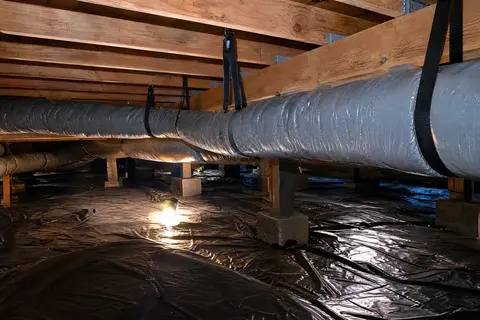
Ducts in a vented crawl sit outside the heated space, and Washington's code asks for R-8 on ducts 3 inches and larger, R-6 on smaller ones. To see the materials a contractor installs, Plumbing Supply and More, which shares an owner with this site, has a duct insulation page. It is useful for comparing what a bid names.
What people ask next
Can I close my foundation vents in winter with operable louvers?
Check before you buy them. In Washington's code, operable louvers trigger the radon vent requirement.
Does a concrete crawl floor still need a plastic ground cover?
The code lets you omit the cover only with a 2-inch concrete floor.
Should I put a radon kit in the crawl space?
No. Washington's health department says not to test a crawl space for exposure. For more on these houses, see the crawl space starting page.
Decide next
Should you seal your ducts or replace them?
- Seal and insulate
- Ducts that are whole but leak at joints and seams
- Replace the runs
- Torn, crushed or disconnected runs, or a new system that needs different ducts
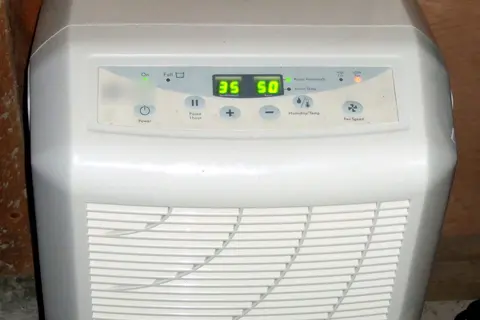
Dehumidifier or more ventilation for a damp Washington house?
- Dehumidifier
- A closed basement or room that stays above 60 percent
- More ventilation
- Steamy bathrooms and moisture made by daily living upstairs
Should you insulate first or replace the equipment first?
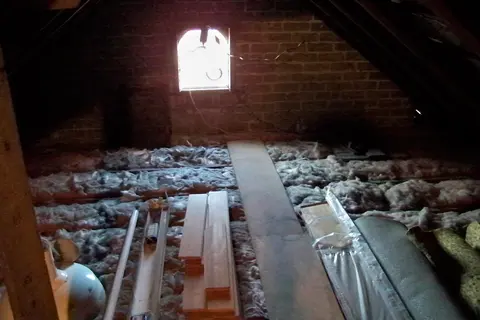
- Insulate and seal first
- A working system in a house with a thin attic or leaks
- Equipment first
- A failed system, or a baseboard house already well insulated
Where this came from
- Washington Legislature: WAC 51-51-0408, under-floor space, checked November 3, 2026.
- Washington Legislature: WAC 51-11R-40320, duct insulation, checked November 3, 2026.
- U.S. DOE: Unvented, conditioned crawlspaces, checked November 3, 2026.
- Building America Solution Center: crawl space article, checked November 3, 2026.
- EPA: Map of radon zones, checked November 3, 2026.
- Washington DOH: Radon, checked November 3, 2026.
- Washington DOH: Mold, checked November 3, 2026.
- PSE: Insulation rebates (archived copy, April 2026), checked November 3, 2026.
- Snohomish County PUD: Weatherization rebates, checked November 3, 2026.
- Clark Public Utilities: Weatherization program, checked November 3, 2026.
- ENERGY STAR: When to replace, checked November 3, 2026.
- L&I: Verify a contractor, checked November 3, 2026.